Every time an Illinois police officer pulls someone over, the state asks them to record the driver's race. Twenty-plus years later, the numbers for Aurora and Oswego are hard to ignore, and the departments have explanations ready.
Since 2004, Illinois has required police to log demographic data for every traffic stop. The Illinois Department of Transportation publishes it each year in a study with a modest title and an immodest page count. The 2025 edition runs to more than a thousand pages. Most people never open it. We did, and went straight to two Fox Valley departments: the Aurora Police Department, which serves Illinois' second-largest city, and the Oswego Police Department, which polices a fast-growing Kendall County village of about 35,000 people.
IDOT warns, every year and in bold, that its ratios "alone do not prove" racial profiling. Benchmarks are imperfect, and people drive through towns they don't live in. That's a fair caveat, and we keep it in mind below. It's also worth noticing which way the numbers point, year after year.
Aurora: four times the stops, three times the searches
In 2023, Aurora police made 17,294 stops that IDOT could compare against its crash-based benchmark, which estimates who is actually on the road. Measured against that benchmark, Black drivers were stopped at 4.1 times the rate of white drivers, and Hispanic drivers at 2.4 times. data1
| Aurora PD, 2023 | White | Black | Hispanic |
|---|---|---|---|
| Stop-rate ratio vs. white drivers | 1.0 | 4.1 | 2.4 |
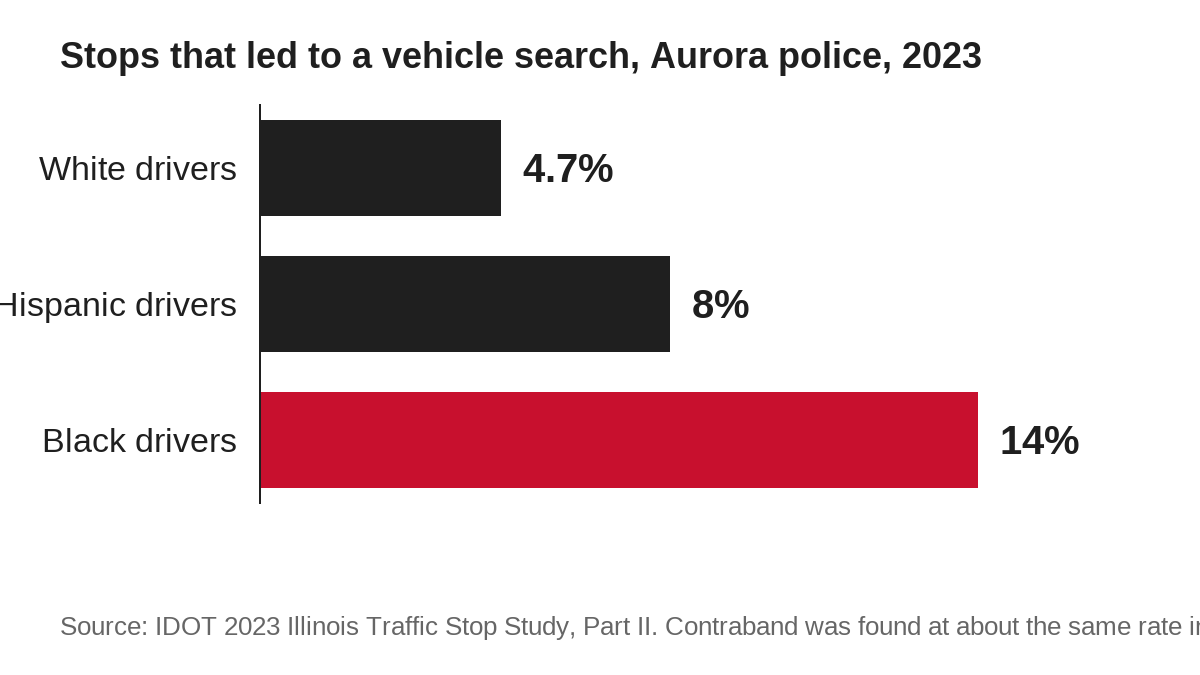
| Vehicles searched (% of stops) | 4.7% | 14% | 8% |
| Consent searches (% of stops) | 1.8% | 3.6% | 3.1% |
| Contraband hit-rate ratio vs. white | 1.0 | 1.1* | 0.95 |
*Not statistically significant. Source: IDOT 2023 Illinois Traffic Stop Study, Part II, pp. 44–45.
Once stopped, Black drivers in Aurora had their vehicles searched in 14% of stops, about three times the white rate. That alone could have an innocent explanation. The next row is harder to explain away. If officers were searching Black drivers more often because they had better reasons to, those searches should turn up contraband more often. They didn't. The hit rate for Black drivers was statistically indistinguishable from the rate for white drivers. Researchers call this an "outcome test." By that test, the extra searches found nothing extra.
This isn't a new pattern in Aurora. In 2014, the ACLU of Illinois analyzed 2013 data and found Aurora officers asked Black drivers for consent searches 2.36 times as often as white drivers. In those searches, white drivers were 30% more likely to be carrying contraband. data2 Injustice Watch, using 2020 figures, reported Black drivers being stopped at 11.5 times the white rate and Latino drivers at nine times. Local organizers described a practice of using minor equipment violations to justify stops. allegation3 WBEZ's twenty-year dataset shows Black drivers made up 23.4% of Aurora stops in 2004 and 20.8% in 2023. In other words, two decades of statewide reporting have barely moved the number. data4
To its credit, Aurora has made changes. In June 2020, then-Chief Kristen Ziman launched a public portal for complaints and discipline and wrote that "law enforcement as a whole has failed our black and brown brothers and sisters."5 Later that year the city created a Civilian Review Board.6 The 2023 stop data came after both reforms.
Inside the department, too
The question of race at Aurora PD isn't limited to the street. Records from the Illinois Labor Relations Board show that, beginning in 2020, members of the department's chapter of NOBLE, a national organization of Black law-enforcement executives, met with the chief about possible racial bias in promotion ratings, special-unit staffing and internal affairs. The city acknowledged receiving discrimination claims from African-American and Hispanic officers. The union's labor complaint over the matter was recommended for dismissal on procedural labor-law grounds. The board did not rule on whether the bias was real. allegation7 Two federal employment-discrimination suits followed in 2022, Pirela v. City of Aurora and Walls v. City of Aurora. Both closed in March 2024. We could not find a public record of how they ended.8
Oswego: a smaller town, a similar pattern
Oswego is not Aurora. It makes about 12,500 stops a year, has no history of high-profile scandals, and searches cars far less often than its larger neighbor. But it shows the same pattern.
| Oswego PD | White | Black | Hispanic |
|---|---|---|---|
| 2025 (12,479 stops) | |||
| Share of stops vs. benchmark | — | 17% vs 8.7% | 29% vs 25% |
| Stop-rate ratio vs. white drivers | 1.0 | 2.3 | 1.4 |
| Vehicles searched (% of stops) | 0.76% | 4.1% | 2.4% |
| Contraband found (% of searches) | 54% | 58% | 66% |
| 2024 (12,730 stops) | |||
| Stop-rate ratio vs. white drivers | 1.0 | 2.2 | 1.5 |
| Vehicles searched (% of stops) | 0.28% | 2.9% | 1.4% |
Source: IDOT 2025 and 2024 Illinois Traffic Stop Study, Part II.
In 2025, Black drivers made up 8.7% of Oswego's estimated driving population and 17% of its stops, a stop-rate ratio of 2.3. data9 They were searched in 4.1% of stops, compared with 0.76% for white drivers, more than five times as often. In 2024 the gap was roughly ten to one.10 The contraband figures again showed no statistically significant difference between groups. The extra searches did not produce more finds.
The Kendall County Sheriff's Office, which patrols the unincorporated land around Oswego, had a similar 2025 pattern: a Black stop-rate ratio of 2.5, and vehicle searches in 5.2% of stops of Black drivers versus 1.2% for white drivers.9
Our searches turned up only one federal lawsuit alleging ethnic bias by Oswego police: Villagrana v. Village of Oswego, filed in 2004. A Mexican-American resident alleged he was arrested without probable cause and "singled out for prosecution based on his national origin." Parts of the case survived the village's motion to dismiss. How it ended is not in the public record. allegation11 We found no reported racist messages or social-media posts by Oswego officers, and no internal bias investigation. When social media described a 2021 fight at an Oswego Portillo's as racially motivated, police investigated and concluded it was not. police finding12
What the numbers can and can't tell you
Here is what we can't say: that any individual stop was racially motivated, or that any named officer profiled anyone. The data can't show that, and we won't pretend it does.
Here is what we can say. In both departments, the state's own data shows Black drivers stopped at more than twice their expected share and searched several times as often as white drivers, without the higher contraband rate that would justify the gap. Illinois built this reporting system so residents could ask exactly this kind of question. Twenty years later, residents of Aurora and Oswego are still waiting for a complete answer.
Next in the series: The Paper Trail, on what's publicly known about officers with complaints, lawsuits and discipline records in both departments, and what isn't public.
Sources
- IDOT, 2023 Illinois Traffic Stop Study, Part II, "Aurora Police," pp. 44–45
- ACLU of Illinois, "Racial Disparity in Consent Searches and Dog Sniff Searches" (Aug. 13, 2014)
- Injustice Watch, Aurora police excessive-force lawsuit coverage (Feb. 2022)
- WBEZ / Investigative Project on Race and Equity, Aurora Police traffic-stop data (Aug. 1, 2024)
- Patch, "Officer Complaints, Discipline To Be Made Public: Aurora Chief" (Jun. 11, 2020)
- City of Aurora, Civilian Review Board
- Illinois Labor Relations Board, Case S-CA-21-023, Recommended Decision and Order
- CourtListener dockets: Pirela v. City of Aurora, 1:22-cv-00866; Walls v. City of Aurora, 1:22-cv-00867
- IDOT, 2025 Illinois Traffic Stop Study, Part II (Oswego Police; Kendall County Sheriff)
- IDOT, 2024 Illinois Traffic Stop Study, Part II (Oswego Police)
- Villagrana v. Village of Oswego, N.D. Ill. 1:04-cv-04603 (docket and opinions)
- Patch, "Portillo's Fight Not Racially Motivated: Oswego Police" (Jun. 2021)
Published . No corrections to date. If you have a record that changes something here, request a correction; we fix it and say what changed.